Friday, June 1, 2018

Jackie Brux Explains US Tax Policy and Microenterprise Credit for Women in East Africa

Prof. Jackie Brux introduced by Bernie Brohaugh
On May 10, 2018, River Falls Area Retired Educators' Association hosted retired UW-River Falls Professor of Economics Jacqueline Brux for some quick lessons in economic issues.  While some wanted to hear about how the new tax policies will affect taxpayers in this country, some were also interested in Jackie's research into economic initiatives in East Africa.  So, we got a little of both.

TAXES:  Jackie began her talk by providing us with some specific information about taxes--before and after the most recent Congressional actions.  She pointed out the fact that tax brackets are temporarily lower for most taxpayers, though the largest breaks come to those Americans with the most income.  The poorest 5th of our nation will receive just 1% of the tax benefits while the top 1% will receive 34% of the benefits.

Corporate taxes have been reduced from a rate of 35% to 21%, a change that will be permanent unless a new Congress changes the laws again.  Despite the claims by many politicians, American taxpayers do not pay higher taxes than other citizens of the major western industrialized countries.  Our maximum personal income tax rate of 37% is the second lowest (only Canada pays less at 33%).  Denmark, Finland, Sweden, and the Netherlands, for instance, all pay above 50%--and have many more social benefits (health care coverage, parental leave, childcare, and retirement benefits) than we do.  As Jackie and others pointed out, it will be interesting to see whether these changes have the positive effects on our economy that have been projected.

EAST AFRICAN WOMEN:  The economic conditions in East Africa are a focus of Jackie's most recent research.  She is particularly interested in how small investments in women's entrepreneurial endeavors changes families' lives. She has examined, for instance, small cooperatives composed of as few as ten women who all contribute a small amount of money, which is then invested in various enterprises to improve their and their families' lives. 

Banks in this part of the world require collateral in order to receive a loan. The cooperatives, on the other hand, require no collateral and charge small interest on the loans.  The women themselves makes sure the loans are repaid.  A condition of the loan is often initial investment in something that will benefit the community, e.g., a contribution to the establishment of a cistern, which will reduce the hours required of women collecting and carrying water from great distances.

With a small investment for women to resell used goods, charcoal, or wood, for instance, women's cooperatives are redistributing assets and income, creating a sustainable economy, and earning enough money to pay their children's school fees, thereby improving their own and their children's lives.

Thanks to Jackie for sharing her knowledge and research with us.


Monday, May 28, 2018

RFAreaREA Delivers School Supplies to Baldwin Elementary School

Spotlight on Education Outreach Initiative


On February 27, 2018, Gail Possley delivered schools supplies to Greenfield Elementary School in the Baldwin-Woodville School district purchased with money received from the WREA's Spotlight on Education Outreach Initiative.  The Board of RFAreaREA agreed on the purchase of supplies needed midyear at the elementary school.  Gail shopped for and presented the supplies to Principal Tiffanie Grodevant and Guidance Counselor Kellie Larson.

Thanks, Gail, for your leadership in this initiative.

RFAreaREA Members Attend 2018 District III Meeting in Eau Claire

We must have set a record for our unit's representation at the District III annual meeting on May 2, 2018.  In attendance at the Wild Ridge Gold and Event Center in Eau Claire were Roger and Patty Hulne, Bonnie Jones-Witthuhn, Tom and Gail Possley, Ruth Wood (District III Co-Chair), and Laura Zlogar.

Gail and Tom Possley in the foreground. 
Roger and Patty Hulne in the center.
Retired Altoona history teacher Betty Cowley gave a very eye-opening presentation on World War II prisoner of war camps in Wisconsin.  She has written a book on the subject entitled Stalag Wisconsin:  Inside WWII Prisoner of War Camps, available on Amazon.  Tom Possley found out that one of the camps was near his hometown, confirmed later by his older brother.
Bonnie Jones-Witthuhn (left) and Laura Zlogar (right)


The meeting was informative and fun.  It is always good to meet people from other units, to compare notes, and to learn from one another.  Featured were presentations by John Forster, our lobbyist and representative in Madison, providing a legislative update; Bob Conlin, ETF Secretary; and Bob Mercer, WREA President, who introduced the winner of the District III WREA Foundation Grant ($2,000) to Oaklawn Elementary School in Menomonie.

Ruth Wood, Lynn Kagelman, and Darlene Parkinson


This year's Division III meeting was organized by outgoing co-leaders Ruth Wood and Darlene Parkinson.  All in attendance agreed that meeting in Eau Claire was a great idea since none of our representatives from around our region had to drive much more than an hour.  We hope we will be returning there next year when new District III Director Lynn Kagelman organizes the meeting.


Tom Possley, WREA President Bill Mercer, and
Gail Possley
RFArea REA President Roger
Hulne and WREA President
Bill Mercert


Legislative Update

John Forester, who serves as a representative/lobbyist for both the Wisconsin School Administrators Alliance (SAA) and WREA, along with Executive Director Diane Wilcenski, provided us with a summary of the issues addressed in the state legislature this term.

Spring Session Education Bills
AB 835--Increase to Low Revenue Ceiling/Sparsity Aid.  Supported by both SAA and WREA.
AB 805--Concurrent Enrollment Fix.  Supported by SAA.
AB 693--Teacher Protection Act.  Did not pass. It would have expanded access to juvenile records and would have allowed teachers unilateral authority to take action against students.  Opposed by both SAA and WREA.
AB307/SB 236--Competitive Bidding.  Did not pass.  This bill would have taken control from local school boards and placed it in legislative control.
AB 843--School Safety package. Passed.  Creates a two-tiered grant process for schools to apply for money to cover door locks, shatterproof glass film, and other safety measures. This bill also called for the arming of teachers.  It is administered through the Department of Justice.
AB324/SB190--Pension Bill. Did not pass, but will no doubt be raised again by Dewey Stroebel.  It increases the age of retirement of teachers and law enforcement officers.  It would change from 3 to 5 years the basis of a person's pension. This bill would also adversely affect new hires.

Next Session
*Everything depends upon the November elections and the makeup of the legislature.  The K-12 budget benefitted from Gov. Walker's reelection campaign wanting to appear favorable to public education.  But the 2019-21 budget will revert to the same difficulties experienced in recent years, especially since Foxconn took $400 billion from the general tax fund, money meant for schools, highways, and other critical state functions.
*Many of the same bills rejected are going to reappear:  Teacher Protection Act, pension reforms, gun bills, competitive bidding, education savings accounts, and charter school expansion.

See the WSAA website for more information:  http://www.wsaa.org/wp-content/uploads/2017/07/Digital-2017-19-Legislative-Agenda-121916-1.pdf.

Blue Ribbon Commission on School Funding
Co-chairs Rep. Joel Kitchens and Sen. Luther Olsen lead a commission of 8 legislators, 7 public members (5 from public education) held 8 listening sessions around the state.  The commission is looking at systems and programs in other states and will make recommendations before the next budget is finalized. Of the 5 sessions held so far, SAA, WREA, and WPEN (Wisconsin Public Education Network) have dominated. Members of these organizations have shown their strong support of public education in this state. 

SAA has been invited to testify at the June 4th meeting in Rice Lake.  John Forester will focus on the following in his testimony:
*Enhance equity in resource distribution (greatest inequities are in areas of low revenue ceilings, declining enrollments, pupil transportation, special education, English language learners, and students in poverty)
*Reduce disparities in educational opportunities (quality of education should not depend on a child's zip code)
*Facilitate attainment of larger education policy objectives (funding should be a tool to improve achievement). This should be achieved by following the evidence, doing what works:  pre-school programs and learning, mental health, revitalizing teaching profession, and other measures
*Index revenue growth to CPI
* Make cost of voucher program transparent by including it on property tax bills


WRS Update

Robert Conlin, ETF Secretary, provided an update of our pension program. Here are a few key points:

  • WRS is well-funded with $107.3 billion in assets, a 99.1% market value.
  • 85% of annuitants stay in Wisconsin after retirement, which amounts to $5.2 billion spent in Wisconsin's economy.  That means, for instance, that Eau Claire County receives $8.8 million a month from WRS pensions.  WRS annuitants spend $1 million a month in Pepin County.  We retirees are economic drivers in the state.
  • WRS comes at a low cost for taxpayers:  state and local governments in Wisconsin spend 2.2% of their budgets on public pensions as opposed to the national average of 4.7%.
  • WRS is composed of 197,000 annuitants, 167,000 public employees with deferred benefits, 1,495 state and local government units throughout Wisconsin, and 257,000 public employees in Wisconsin's state agencies, UW System, technical colleges, school districts, cities, counties, and local units of government
  • The median annual benefit is $18,139.
  • Annuity investment returns for 2017 were 16.2% for the core fund and 23.2% for the variable fund. These translated into 2.4% annuity adjustments for the core fund and 17% for the variable. 
  • The 10-year performance rate of the core fund is 5.8%, 7.1% for the variable.
  • Adjustment projections over the next five years depend on the stock market. The best case scenario for the core based on a 7.2% gain could be 2.0% in 2018, 2.2% in 2019, 3.5% in 2020, and 3.4% in 2021.  The worst case scenario based on -5% could be -0.8% in 2018, -0.8% in 2019, 0.5% in 2020, and 0.0% in 2021.


Tuesday, May 8, 2018

Peace Corps Revisited: Don and Ann Leake's Year in Sierra Leone

Ann and Don Leake met 40 years ago as housemates in their Peace Corps posting in the Republic of Congo.  Don taught math; Ann taught English.  At our April 2018 RFAreaREA meeting, they described it as a life-changing experience.  When Don ended his career as a math professor at UW-River Falls and Ann retired from teaching English as a second language in Minnesota public schools--and a post-retirement stint in the English Language Transition Program for international students--they were looking for the next adventure.

The Peace Corps encourages its alumni to do it one more time for shorter periods of time.  The Leakes applied, were accepted, and got ready to return to Africa, this time as to a university in Sierra Leone as teacher trainers for eleven months.


They spent two weeks in the large city of Freetown, Sierra Leone, learning a little bit of the language and the culture before heading to Kenema, the country's second largest city, and to Eastern Polytechnic University.  Upon arrival, Ann and Don discovered that the university had no real idea why they were there and that they would have to invent their own jobs.

The Leakes lived on campus in a decent house, given local standards, that had no running water and unreliable electricity. They did have one propane burner on which to cook.  Water had to be carried from the well some distance away or collected from the roof during rainstorms.  Bathing and laundry were major undertakings.  Solar-powered lights that they were advised to bring with them provided enough illumination to read in the evenings.

Sierra Leone's educational system follows the British model inasmuch as the country was at one time a British colony.  This system relies upon testing, the results of which determine where students will attend school or college.  Eastern Polytechnic had been completely destroyed during the political revolution twenty years ago and is still in the process of rebuilding.  It has a library building but no books available to students.  The only resources available to teachers and students are chalkboards, paper, and pencils.  Students take 12 to 15 subjects a week, spending one to two hours a week studying a specific subject.   Class sizes averaged 50 to 60 students.

Don taught math at the university and Ann English.  Her students were primarily nursing students.  Ann decided that her efforts might be more meaningfully directed at the neighboring elementary school where she volunteered.  She spent time in a fifth-grade classroom, built to hold 30 students, teaching more than 90 students.  Teachers rely on lots of memorization, repetition, and recitation.  Ann also learned, to her dismay, that schools practice regular corporal punishment.  When she suggested that there might be other ways to discipline students, she was told, "African children need to be beaten."

The sense of accomplishment they gained during their first Peace Corps stint was not repeated this time.  Both Leakes thought they might have affected the lives of a few students, but they certainly were able to share any of their knowledge with the university's teacher training faculty, who were simply not interested in American teaching techniques or philosophy. 

Not to be discouraged, the Leakes are planning yet another adventure.  Rumors are that they may be headed to Morocco!

Sunday, March 25, 2018

RFAreaREA Meeting--March 8, 2018--Rock Talk


Rock Talk

By Larry Harred

Rocks, fault lines, mines, and meteors:  Our RFArea REA meeting on March 8, 2018, featured a presentation by Dr. William Cordua on western Wisconsin’s wild geology.

Dr. Cordua began his talk by telling his audience that geology is everywhere—even in Wisconsin—and offered some interesting local examples.  After presenting a general geological history of Wisconsin, illustrating the chronology with a map of glacial drift coverage and a chart of rock formations, Dr. Cordua discussed this “layer cake” of rocks in more detail, moving from the deepest and most ancient, the Cambrian Sandstone, to the shallowest and most recent, the Platteville and Decorah formations.

With maps, photos, and other illustrations, Dr. Cordua told the stories of four sites of geologic interest in western Wisconsin.  If you drive along Hanley Road near Hudson, you can observe the first: the results of the geologic upheaval that occurs along major fault lines.  The second is nearby, in Knapp.  The Knapp Gold Mine, active from 1920 through 1925, uncovered the precious metal that had been deposited by glacial drift.  Panning for gold in the area may still net a person small particles of “flour gold.” The iron mined in the late 19th and early 20th centuries at the third site, the Gilman Iron Mine, was deposited in a similar manner.  And finally, though it is hard to spot from the ground, the nearly perfect circle of the Rock Elm Disturbance is easily visible on satellite imagery.  This feature is in fact the impact crater left by a large meteor.

Dr. Cordua ended the presentation by answering questions about a variety of subjects, from geologists’ methods to the diamonds of Plum City.

Dr. Cordua earned his undergraduate degree from George Washington University and his M.A. and Ph.D. from Indiana University.  He joined the geology faculty at UW-River Falls in 1973 and retired in 2012.  He is a member of the Wisconsin Geological Science Hall of Fame and has won an award from the Museum of Geology/Earth Science in Oshkosh, WI.

Tuesday, February 27, 2018

Geographer Michael Albert Featured Speaker at Feb. 2018 Meeting


Dr. Michael Albert Enlightens Us About Clouds

By Jane Harred

Who among us hasn’t had a memorable experience with the weather?  We can all recall monster hailstorms or violent winds, and I am acquainted with several people who have been struck by lightning and lived to tell the tale.  And let’s not forget picnics under blue skies and fleecy clouds or sunsets viewed from a warm beach.

At our February 2018 meeting, cultural geographer Dr. Michael Albert’s presentation, “Short-Term Weather Forecasting from Cloud Formations,” got us all ready to look at the sky, identify clouds, and predict what’s coming.

Dr. Albert’s presentation described features of four types and several subtypes of clouds, accompanied with many images, to help us learn to identify clouds’ formations and altitudes and offered tips on using these identifications to predict the weather.  His audience can now all dispense with those TV weather people and their hype because we know what sorts of clouds indicate fair weather is ahead or what to expect when a cloud develops the shape of an anvil.

And since we all like—or at least like to hear about—dramatic weather events, Dr. Albert concluded his presentation with some “weather porn”:  images and descriptions of violent weather and the mayhem it can cause as well as the beauty it can bring:  double rainbows, colorful sunsets.

Dr. Albert is a retired UW-River Falls professor of geography.  He earned his PhD from the University of Minnesota with a focus on urban geography.  As an undergraduate at the University of Pennsylvania, he studied both geography and meteorology.  His interest in weather and climate extends back to dramatic weather he experienced during his childhood.  He participated in the Minnesota State Climatologist’s Backyard Rain Gauge Network from 1978 to 1992 and has served as a Skywarn Spotter for the National Weather Service.

Monday, December 18, 2017

Holiday Cheer

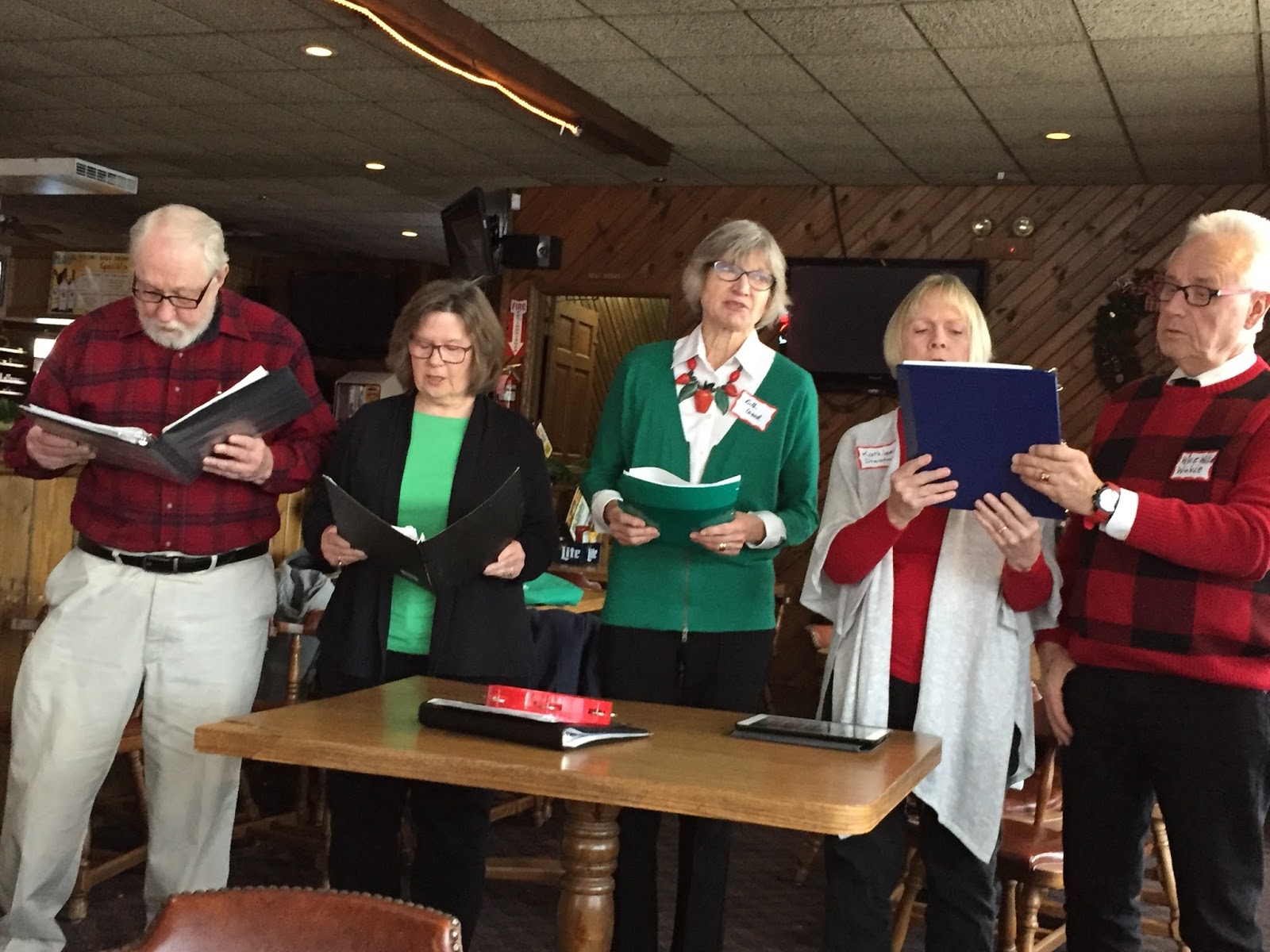
RFArea REA held its annual holiday meeting on December 14th at St. Croix Lanes in River Falls. Though not many members were able to attend, those who were there enjoyed a radio play--written by Bernie Brohaugh--and carols sung by our members, and door prizes.

Tom Possley and Nancy Peters read "news"
account of Old Mother Hubbard's child care

Members enjoy socializing at the
 December meeting.


Bernie Brohaugh, Jane Harred, Ruth Wood,
Kathleen Drecktrah, and Tom Gunderson perform.

We know that some of our members have already retreated to warmer climes (Cheryl Maplethorpe off to the West Coast), and some are enjoying an around-the-world cruise (Gorden Hedahl and Jean Loudon).  Some are substitute teaching and have other commitments on Thursdays.  But it would certainly be nice to see more members at our monthly meetings.

Some units across the state see as many as 50 to 75 members at each of their regular meetings. And many of those units have more than 100 members.  We have a total of 73 members, including emeritus members, in our local unit. We also have 6 new members this year so far!  However, we have many members who still have not paid their annual dues.  We will be finalizing our unit directory, and any member who has not paid dues by December 30th will be dropped from our membership list.

We have had great speakers and programs over the past months--and great ones are scheduled for the new year. We wish more of our members would come out to enjoy the speakers and programs. Additionally, we hope that you are sharing with friends and former colleagues just how important WREA is in protecting our pensions and public education. Membership supports a presence and a voice in Madison that represent us! 

More former educators, staff members, and administrators need to know that their pension checks are not necessarily guaranteed forever--at least not at the levels they may be expecting. The tax bill currently under consideration in Washington will tax pension organizations like ETF, which will, in turn, mean lower rates of return for people like us.  Medicare and Social Security are also threatened by recent Congressional actions.  WREA is vigilant in protecting our interests as retirees.  It also serves as a watchdog against threats to public education.  For these reasons, your membership and that of your friends and colleagues are so important.

State WREA dues are $50 annually. Local dues are $10.  Active teachers can also join WREA as associate members for $30 per year.  Please renew your membership if you haven't done so already and encourage others to join us, especially your friends who taught in area public schools.  We promise to quit nagging you if we hear from you soon.